
 Last summer I discovered one of my all-time favorite pilgrimage destinations: the Blessed Stanley Rother Shrine in Oklahoma City. The Shrine includes a museum, chapel, plaza, and large church, as well as a walking trail up a hill to a shrine to Our Lady of Guadalupe. Since it was over 100 degrees during my visit, I didn’t explore the trail!
Father Stanley Rother was a priest of the Archdiocese of Oklahoma City. A native of a farming community in Okarche, Oklahoma, he began to discern his vocation in high school. After studies and his ordination in 1963, he served as an associate pastor in Oklahoma for five years. Feeling called to mission work, he became a missionary to Santiago Atitlan, Guatemala.
There, he served the Tz’utujil, a native tribe descended from the Mayans. After learning their difficult language, he helped translate the New Testament into it. He used his farming skills to help improve the local farms, including building an irrigation system. As he lived among his people, experiencing their daily lives and poverty, he helped them with medical issues as well as catechesis and education.
Unfortunately, violent conflict between the military government and guerillas made the Catholic Church a target, including his community. Many Catholics were killed, and Fr. Rother’s name appeared on a death list. Some of his parishioners were kidnapped, tortured, and killed. Although he left temporarily for the safety of Oklahoma, he soon returned. Despite the danger he faced, Blessed Stanley continued serving the Tz-utujil. “The shepherd cannot run,” he explained simply. Shortly after his return, three armed men entered the rectory in the middle of the night. Fr. Rother fought them so colleagues could escape. The men shot him, killing him instantly.
In 2016 Pope Francis recognized Fr. Rother as a martyr — the first one officially recognized from the United States. He also is the first U.S.-born priest to be beatified, that is, the final stage before canonization as a saint by the Catholic Church. Meanwhile, the beautiful shrine in Oklahoma City is attracting pilgrims from all over the world.
 I started my visit by walking outside the shrine on a large plaza. The twin bell towers flank the main entrance of this Spanish mission style church. Deep red tiles decorate the sanctuary dome, the bell towers’ smaller domes, and much of the church’s roof.
Before going inside the church, I recommend stopping at the Pilgrim Center across the plaza. There, you’ll find a wealth of information about the Shrine, a large gift shop, a museum, and a film center. A documentary called “An Ordinary Martyr” gives a wonderful overview of Blessed Stanley’s life. The museum contain exhibits about his childhood, priesthood, mission, and martyrdom. Endearing family photos, the wooden tabernacle from the Marian altar at his home parish church in Okarche, the cake topper from his ordination, and a photo of Father Stanley in a baseball cap and poncho at the lake in his Guatemalan parish make his life very relatable. Beautiful icons and paintings capture what seems to have been a spirit of kindness in the sparkling eyes of a smiling Blessed Stanley Rother.
Next, with the benefit of what you’ve learned at the Pilgrim center, make your way across the plaza to enter the church. Inside, a solid wooden beamed ceiling matches the dark wood pews. The simplicity and straight lines of the white walls and dark roof accentuate the brightly colored and carved furnishings within the church.
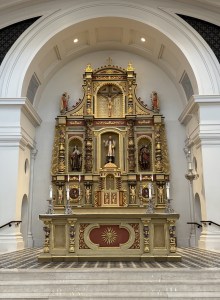 Your eyes immediately go to the stunning retablo, a decorative wooden wall ornament, that dominates the sanctuary’s back wall. Characteristic of Spanish colonial architecture, this elaborately carved and painted retablo is pale gray with brilliant accents of gold, red, and blue. Beneath a 19th-century crucifix, a statue of Blessed Stanley Rother lifts his hand in blessing.
 At the center of the retablo is the tabernacle with images of grapes, vines, and wheat. Under the tabernacle’s dome, the top and crossbeams of a crucifix end in carved shells, a symbol of pilgrimage.
Two statues – one of Mary holding the infant Jesus and the other of Saint Joseph – stand on either side of the altar. The members of the Holy Family all have dark auburn hair, just like that of Blessed Stanley. Baby Jesus’ hairline also bears a striking resemblance to that of Blessed Stanley.
Behind the sanctuary, light fills a chapel containing Blessed Stanley Rother’s tomb. Beams of gold on the tomb’s black iron grill echo beams of light that radiate from the Blessed Sacrament depicted on the chapel’s tabernacle.

Light also surrounds the figures in a beautifully painted mural on the ceiling. The mural shows Blessed Stanley kneeling before Jesus who welcomes him to Heaven. Our Lord wears priestly garments and opens his arms wide as he reaches out to Blessed Stanley. Other martyrs surround Jesus. At His feet are the charming Holy Innocents – the toddlers and babies massacred by Herod’s soldiers seeking to kill the infant King of the Jews. To Christ’s right, John the Baptist kneels among a group of martyrs including Saints Thomas More, Miguel Pro, and Oscar Romero, another victim of government violence from a neighboring country that suffered civil war like that in Guatemala. To Christ’s left, a throng of martyrs includes Saints Agnes, Joan of Arc, Peter, and Paul. This wonderful mural contains an entire catechesis in paint.
At the rear of the chapel, a statue of Blessed Stanley displays a first-class relic of his bones in its base. The statue gazes at the sanctuary and holds a palm branch in one hand. You’ll find that palm branch in many other spots, including a stylized version used as the Shrine’s logo. The Shrine’s website movingly describes how the palm branch represents Blessed Stanley’s final trip back to Guatemala shortly before Palm Sunday. More generally, palm branches represent the sacrificial journey of Jesus to Jerusalem, his victory on the cross, and the eternal life into which we can now enter. As we walk through this earth as pilgrims, we follow in the footsteps of Christ, the saints, and martyrs, including Blessed Stanley Rother.
The Shrine is located at 700 S.E. 89th Street in Oklahoma City. On the Shrine website, you’ll find detailed information to help you prepare for your visit. Daily Mass is at 12:15 p.m. with a Saturday evening vigil Mass at 5 p.m. and several Masses throughout the day on Sunday.
This post is a condensation of “A Modern Martyr from Oklahoma,” an article I wrote for FAMIGLIA Messenger originally published in the October 2024 issue of FAMIGLIA Catholic Family Messenger.

Leave a Reply